How a Social Enterprise actually works
Five core Social Enterprise business models (and how impact drives revenue in each)
After people learn what a Social Enterprise is (and what it isn’t)… the next question you might ask is: “Okay… but how does this actually work?”
Here’s the key:
At its root, Social Enterprise is a business model. It is an approach to doing business that weaves doing good (impact!) into earning revenue (sales!), and it can be used in any type of legal designation (for-profit or non-profit).
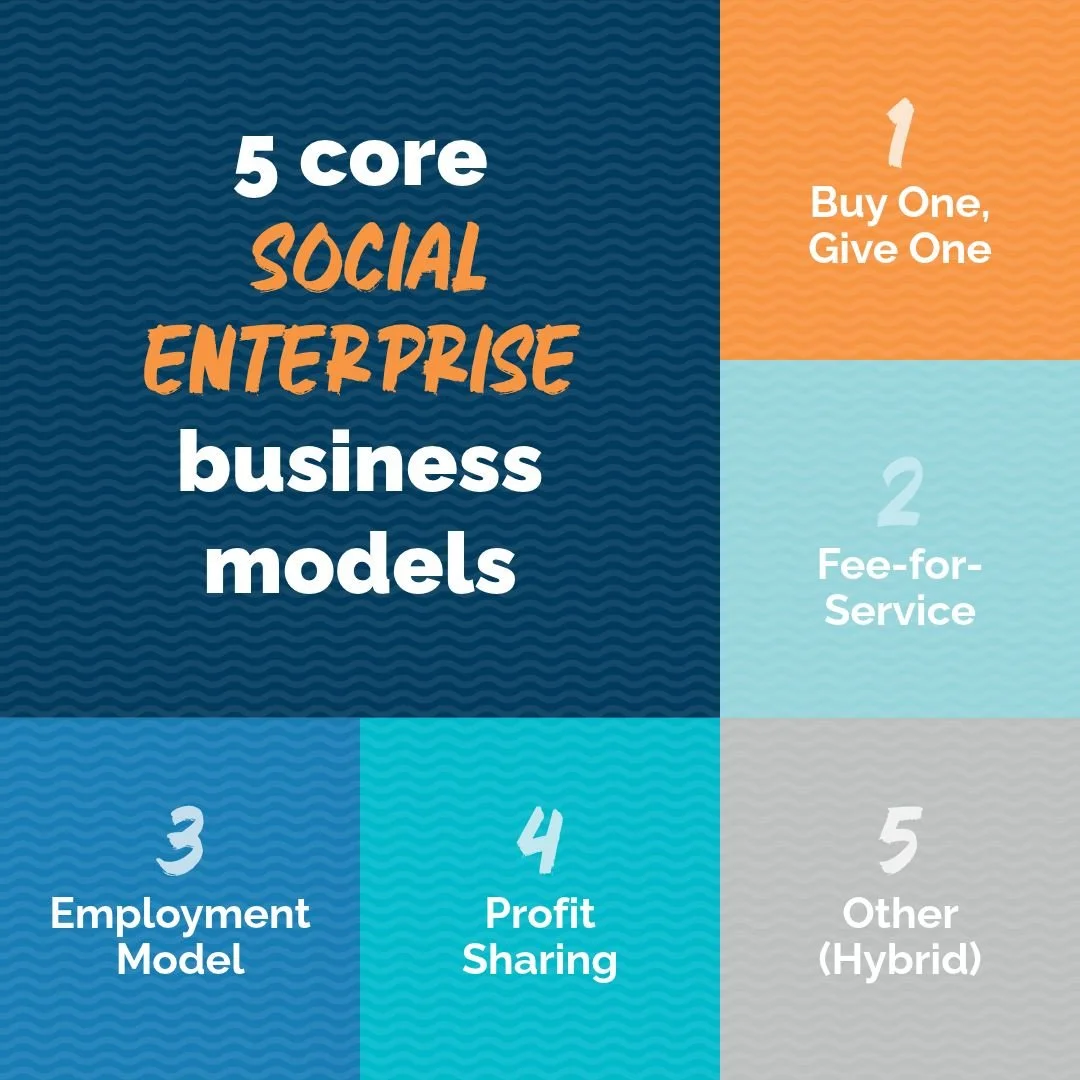
At SEA Change, we teach that there are five core business models that do this really well.
Other (Hybrid, Ecosystem, or one-off types of models)
Let’s dive into each!
The five most common Social Enterprise business models
The five most common models connect sales and impact together in clear, direct, and measurable ways.
1. Buy One, Give One
How it works:
For every set number of products sold, a set number of products are given to those in need.
National Examples:
Did you know? TOMS pioneered One for One back in 2006. In 2021, it shifted to giving at least one-third of its profits to grassroots organizations, and it brought One for One back for its 20th anniversary in 2026!
SEA Change Alumni examples:
👉 Impact is directly tied to each transaction.
2. Fee-for-Service
How it works:
Revenue from one group subsidizes access for another.
You sell programming or services to people who can afford it, and that revenue supports providing those same services to people in need for free or at a reduced cost (using a sliding scale pricing model).
Simply put: people who can pay, pay. People who can’t, don’t (or pay less)!
National examples:
SAME Café - a pay-what-you-can café in Denver (with a second spot in Toledo, Ohio!) where guests pay what they can, volunteer for 30 minutes, or bring fresh produce, so everyone eats with dignity.
SEA Change Alumni examples:
Barley Moon Botanicals - specialty honey and merch sales keep their therapeutic beehive experiences free for veterans and first responders
Buds in Bloom - sliding scale forest therapy
Caroline Inspires - paid speaking, coaching, and consulting fuel leadership and mentorship programs for Black and underrepresented youth
Fort Buffalo - sliding scale art workshops
Makerspace Central - sliding scale STEM/STEAM experiences
Yocum Law - sliding scale legal services
👉 The service itself is the impact — and it’s distributed equitably.
3. Employment
How it works:
You provide holistic, wraparound employment and HR support for individuals who face barriers to traditional employment — while also selling goods or services on the open market.
This might include:
Individuals who have been incarcerated
Survivors of human trafficking
Individuals with disabilities
Individuals who are undereducated
National examples:
Greyston Bakery - a commercial bakery that creates opportunities for people facing barriers to employment. - founded in 1982 to give people facing barriers to employment a fresh start through Open Hiring: anyone can put their name on a list for the next open job. No resume, no interview, no background check! Their motto says it all: “We don’t hire people to bake brownies; we bake brownies to hire people.”
Did you know? Greyston bakes the brownies in your Ben & Jerry’s Chocolate Fudge Brownie!
Homeboy Industries - a bakery, café, catering company, and more in Los Angeles that provides jobs, training, and wraparound support (think tattoo removal and mental health services) to formerly gang-involved and previously incarcerated folks.
Freedom a la Cart - a Columbus, Ohio lunch and catering service that employs survivors of human trafficking.
SEA Change Alumni examples:
Growlers Dog Bones - creates all-natural dog treats and serves individuals with disabilities through vocational training and employment.
Posh Teatime Co. - a luxury tea time experience that teaches social etiquette skills and employs at-risk youth.
Whole Latte Love Cafe - a cafe that provides meaningful employment for differently-abled adults.
👉 Employment = impact.
Revenue sustains the business, and the business creates opportunity for people who have struggled to find a step up.
4. Profit Sharing
How it works:
A portion of profits is donated to a specific cause.
National examples:
Newman’s Own - salad dressing (and so much more!) that started as homemade holiday gifts. When it turned a profit its very first year, Paul Newman said “Let’s give it all away,” and 100% of profits have gone to charity ever since (more than $600 million!).
Who Gives A Crap - toilet paper with a sense of humor! Founded in 2012 to tackle the global sanitation crisis, they’ve donated 50% of their profits to clean water and sanitation nonprofits from day one!
The Roosevelt Coffeehouse - coffee and justice for all
SEA Change Alumni example:
Ciela Handmade - ethical fashion accessories made by Wayúu women artisans in Colombia; all proceeds from its Origen Shop fund education for youth in La Guajira in their indigenous language.
⚠️ Important distinction:
While this is becoming a more common business practice, in order to be a Social Enterprise the reason for the venture to exist (the mission) is to make money to be donated for a specific type (or types) of impact.
Lots of businesses give a little back these days (yay!). But to be a Social Enterprise, giving it away has to be the WHY. The whole reason the venture exists (the mission) is to make money so it can be donated to a specific type (or types) of impact.
There’s NOT a set target for how much has to be donated, which is what makes this one a little messy.
5. Other (Hybrid or Ecosystem Models)
Not every Social Enterprise fits neatly into a box — and that’s okay.
National example:
Goodwill Enterprises - the largest workforce development nonprofit in North America and a key driver of the circular economy.
SEA Change Alumni examples:
BESA - fulfills critical needs by connecting people to community service to make giving back easy
For the Love of Primates - a sanctuary for primates retired from research, used in the entertainment industry, or previously kept as “pets” (they would be euthanized otherwise!).
POINT App - connects volunteers and provides critical data to nonprofits
The Superhero Project - youth who have been impacted by serious illnesses receive inspiring illustrated posters of themselves depicted as superheroes.
Important: Not every organization “doing good” is a Social Enterprise
You might be thinking:
My company gives back... we do volunteer days and food drives, and at Christmas we adopt a family. Is that a Social Enterprise?
Those are all ways to do good while doing business, but they are not the same thing as Social Enterprise.
In fact, at SEA Change we often talk about the five primary ways to do good while doing business:
a nonprofit running a Social Enterprise model
a for-profit Social Enterprise
a benefit corporation
B Corp Certification
Conscious Capitalism
Two of those are Social Enterprise. Three are not.
They are all doing good, and they can sometimes overlap, but they are not interchangeable!
Why? Because in those other ways of doing good:
Impact may be emphasized
Values are likely embedded
Social responsibility is typically emphasized
But, impact is not always the reason the business was started.
👉 In a Social Enterprise, you are starting a business because you want to do good. The WHY makes all the difference.
So… which model fits you?
If your business is early-stage (1-5 years in business), you don’t need to have the perfect answer today. Iteration is a natural part of the process.
Start here:
What are you wanting to sell?
Can you sell it for more to one person and less to another?
→ Buy one, Give one OR Fee for Service
Is your mission to hire people who otherwise might struggle to find a job?
→ Employment
Do you really just want to do your thing, and you recognize there are other experts out there solving the problem(s) you most care about?
→ Profit sharing
Do multiple of the above sound good? Or do you have another way to make money and also do good?
→ Hybrid or “other!”
That’s your starting point to do good from day one!

Want help designing your business model?
Module 3 of the SEA Change Curriculum — “All the Pieces Work Together” — walks you through how to design your business model. Because when your business model is clear, your impact becomes scalable.